What Is a Service Level Agreement? SLA Basics Explained
Updated on
Jana Sauer
Your product is promised to customers with 99.9% uptime and a four-hour response time for anything critical. Then a database node fails at 2 a.m. on a Saturday, nobody gets paged, and the fix doesn't land for nine hours. Now you're not just debugging a database but also explaining a breach to whoever signed that contract. This is usually the moment someone finally reads the service level agreement closely, instead of just skimming it during procurement.
Service level agreements show up everywhere in B2B tech: cloud hosting contracts, SaaS subscriptions, internal agreements between an ops team and the rest of the company. But most people who work with them day to day would struggle to explain what actually makes an SLA different from a KPI, how many types exist, or whether missing one has any real teeth. That's what this post walks through.
TL;DR:
A Service Level Agreement defines the quality of the provided service rather than the provided service itself.
SLAs create a clear understanding of what can be expected from a provider and what the consequences are when the agreement is breached.
Key Performance Indicators (KPIs) measure how well a service is performing and whether it's actually meeting the SLA, while the SLA itself sets the legally binding target.
There are customer-based, service-based and multi-level SLAs. Customer-based SLAs are individual to each customer, service-based SLAs are identical for every customer. Multi-level SLAs have a base layer that applies to everyone, which can be complemented with additional "SLA layers" for certain customers or services.
SLAs should be tracked rigorously to ensure that they are met. This is done with (uptime) monitoring.
What Is Meant by Service Level Agreement?
A service level agreement is a contract, or a clause within one, in which a service provider commits to a defined level of service. It sets measurable targets like uptime percentage, response time, and resolution time and typically spells out what happens if the provider misses them, from service credits to the right to terminate the contract.
The key word is measurable. "We'll provide good support" isn't an SLA. "We'll acknowledge critical tickets within four hours, 95% of the time" is. If a commitment can't be tracked against a number, it doesn't function as an SLA.
Why Service Level Agreements Matter
Without a documented SLA, "critical" means something different to a customer than it does to whoever is on call. One side assumes a fix within the hour, the other assumes a fix by end of week. An SLA turns that mismatch into a number both sides agreed to in advance.
For the team on the receiving end of the pager, a clear SLA is also protection. If the contract says four-hour response for high severity issues, that's the target the on-call engineer is measured against.
For customers, the SLA is what turns a vague promise into something with recourse. If a hosting provider misses its uptime target for the month, the contract usually defines exactly what the customer gets back: a service credit, a fee reduction, sometimes an exit clause after repeated breaches.
What Is the Difference Between KPI and SLAs?
The two get mixed up constantly because they often measure the same underlying things like response time, resolution time, and uptime, just for different audiences.
A KPI (key performance indicator) is an internal metric a team tracks to gauge how well a process is running. An SLA is an external commitment, usually contractual, that defines the minimum acceptable outcome for a customer or business partner.
In practice, the numbers are rarely identical. A support team might track an internal KPI of 45 minutes average response time, while the contractual SLA they've signed promises four hours. The gap is an intentional buffer, so one bad day doesn't automatically become a breach. This table gives you an overview of the different characteristics of KPIs and SLAs.
KPI | SLA | |
|---|---|---|
Audience | Internal team | Customer or contract partner |
Purpose | Measure and improve performance | Guarantee a minimum outcome |
Consequence of missing it | Internal review, process change | Service credit, penalty, contract clause |
Flexibility | Can change anytime internally | Fixed until the contract is renegotiated |
What Are the Three Types of SLA?
Most SLA frameworks describe three standard types, differentiated by who they cover and how broadly.
Customer-Based SLA
Covers every service one specific customer uses from a provider, bundled into a single agreement. An enterprise client running hosting, monitoring, and support through one vendor might get a single customer-based SLA covering all three, with different targets for each service inside it.
Service-Based SLA
Applies the same terms to every customer using a particular service, regardless of who they are. A cloud provider's public uptime commitment — say, 99.95% for its storage service — is a service-based SLA. Everyone on that tier gets the identical guarantee.
Multi-Level SLA
Splits commitments across layers: corporate level (applies to everyone), customer level (specific to one account), and service level (specific to one product). Larger vendors use this structure when they sell several products to enterprise accounts with individually negotiated terms. A base SLA covers everyone, and additional layers stack on top for specific customers or services.
Which type you need depends on how many services you sell and how much you customize terms per customer. A small SaaS company selling one product usually only needs a service-based SLA. A vendor selling a bundle of services to enterprise accounts often ends up with a multi-level structure by necessity.
Is an SLA Legally Binding?
Yes, if it's part of a signed contract or explicitly referenced by one. An SLA embedded in a Master Service Agreement or incorporated by reference into a Terms of Service is enforceable the same way any other contract clause is. Missing the agreed targets typically doesn't lead to a lawsuit. Instead, it triggers whatever remedy the contract specifies, most often a service credit.
A provider's public status page showing "99.98% uptime this month" isn't automatically an SLA. It's only enforceable if that number, or one like it, is written into an actual agreement with defined consequences. A badge on a marketing page is a claim, not a contract.
What Does a 4 Hour SLA Mean?
This one trips people up because "4-hour SLA" almost never means "your problem gets fixed within four hours." It usually means the provider will acknowledge or respond to the issue within that window, while resolution is a separate, and often much longer, commitment.
SLAs are typically tiered by severity. A common structure looks something like:
Sev1/Critical gets a 4-hour response with 24/7 coverage
Sev2/Major gets next-business-day response
Sev3/Minor gets three business days
The "4-hour SLA" people quote when describing a vendor is almost always the top tier.
The other detail worth checking: is that four hours calendar time or business hours? A "4-hour SLA" that only counts business hours could mean a Friday afternoon ticket doesn't technically breach until Monday morning. Read the definition of "business hours" in the contract before assuming what the clock actually means.
Turning SLA Targets Into Something You Can Actually Track
Defining a target is the easy part. Proving you hit it is where the real work happens. That means monitoring that notices an outage before a customer does, an on-call rotation that gets the right person paged inside the response window, and a status page that shows real uptime history instead of asking customers to take your word for it.
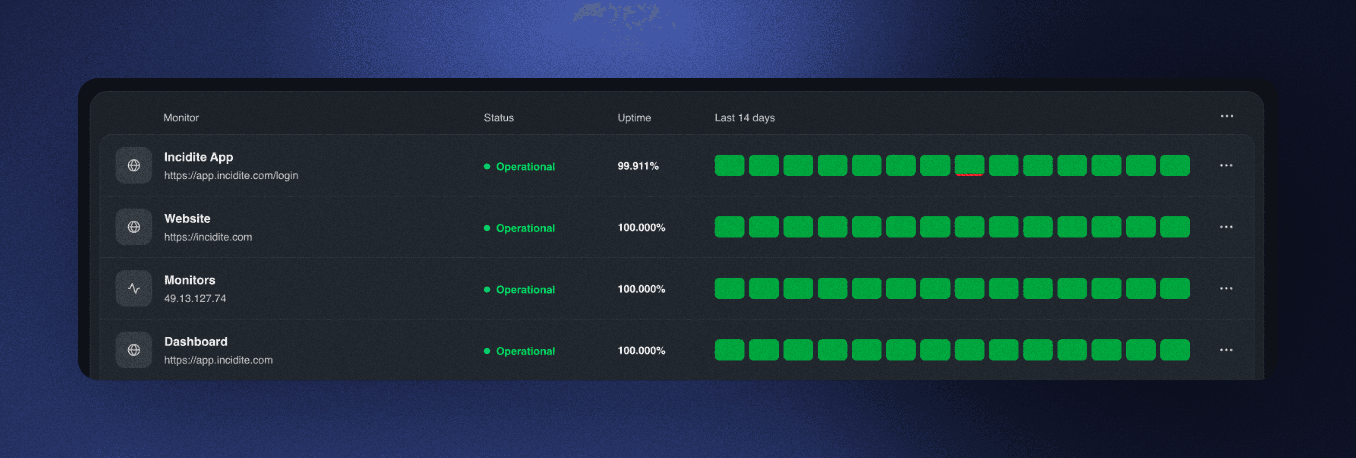
This is the part of SLA management that tools like Incidite are built around: uptime monitoring that automatically opens an incident when a service goes down, on-call scheduling so the right person is paged the moment the clock starts ticking, and status pages that display actual uptime numbers rather than a marketing claim. If you're setting up SLA tracking from scratch, Incidite's free plan covers the basics, and paid plans start at 16 EUR/month billed annually (on-call scheduling is part of the Pro plan at 41 EUR/month). This is what an overview of your services and their availabilities would look like:
An SLA is what turns "we'll take care of it" into something measurable, and usually enforceable. Whether you're the one signing an SLA or the one being held to it, the details that actually matter are almost always in the fine print, not the summary. Give that part a bit more attention.
FAQ Service Level Agreement
What does 99.99% SLA mean?
What does 100% SLA mean?
Thanks for reading!
Got a suggestion or need help? Let us know