What is Incident Management? Processes and Best Practices explained
Updated on
Jana Sauer
Incident management is an essential component for any company with a digital presence, infrastructure, or product. Whether dealing with IT outages, security breaches, service interruptions, or external crises, structured incident management allows organizations to react quickly and efficiently to disruptions. This is especially critical when customers are directly affected by these outages.
This article explains why IT incident management and supporting incident management software have become essential for modern businesses, and how they are used across different industries.
TL;DR:
Incident management refers to holistic strategies to fix acute or ongoing service disruptions.
Incidents are acute events that affect digital infrastructure and can impact the availability of digital services. They are usually resolved within a few hours.
Problems are the underlying risks for digital services, because they can repeatedly cause incidents. Solving problems often takes more time and requires deeper analysis.
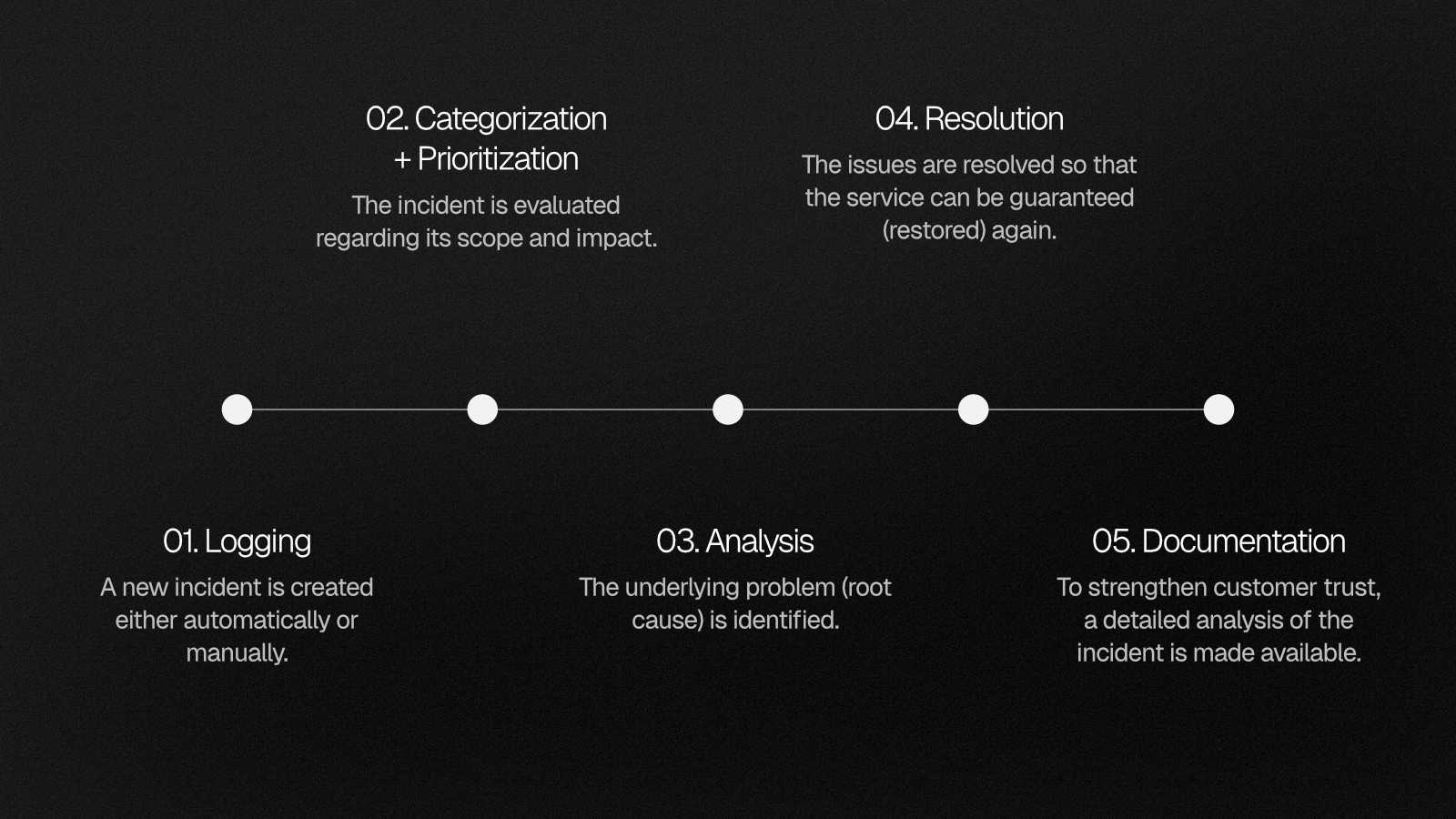
The incident management process is usually divided into 5 steps: detection, categorization, analysis, resolution and documentation.
Incident management is essential for modern companies because it ensures quality and availability and keeps processes clear and structured.
What is Incident Management?
Incident management includes all processes, tools and measures needed to identify, analyze and resolve disruptions in operations. The goal is to minimize negative effects on customers, systems and business processes.
Because companies now work more and more digitally, IT incident management is the most common form. IT systems are the backbone of almost every industry, so a clear structure for handling technical incidents is essential.
Incidents vs problems: what’s the difference?
It is important to distinguish between the symptom and the cause.
⚡️ Incidents are acute, unplanned events that cause impairments—or will lead to them if a problem isn't solved. They usually lower a company's service quality but can typically be resolved in a foreseeable timeframe by identifying the source and applying a targeted fix. Examples include a website being down, errors during checkout in an online shop, or limited availability of cloud-based software.
⚠️ Problems, on the other hand, are deeper, often structural issues that frequently lead to incidents and take more time to fully resolve. These include things like security vulnerabilities, technical debt, or faulty core hardware.
IT incident management: the basic 5-step process
IT incident management covers all events that could impact IT services – from a simple software bug to a major cyberattack. A well-organized IT incident management process usually includes:
Capturing incidents via monitoring tools or user reports
Categorizing and prioritizing them (e.g. critical, high, medium, low)
Analyzing possible causes
Fixing the issue quickly to restore normal operations
Documenting the incident to support continuous improvement
Most companies use specialized incident management software for this. It provides automatic alerts, workflow automation and real-time communication.
Why incident management software is essential
Modern incident management software supports IT teams and other departments by:
Collecting all incidents in one place and showing them clearly
Automating workflows and defining responsibilities
Managing escalations
Simplifying communication within the team and with customers
Providing reports and analytics for optimization
Many providers now offer integrated incident management platforms that connect IT incidents with security incidents, service interruptions, crisis processes and communication workflows.
You can see how this works in practice here.
Incident management and crisis communication
Effective incident management and crisis communication belong together. Without a clear communication strategy, incidents can quickly turn into real crises – especially IT incidents that directly affect customers or partners.
An integrated solution for incident management and crisis communication ensures that:
all stakeholders, customers and users are informed in time,
communication channels are standardized,
misinformation is avoided,
the response remains transparent inside the company and towards customers.
This combination is especially important in industries with high service expectations, such as IT service providers, cloud companies, e-commerce, banks or energy suppliers.
You can find out more about proactive incident communication here.
Which other industries benefit from incident management?
Even though incident management is most common in IT companies, it is valuable for many other sectors:
🏥 Healthcare
Hospitals and care facilities use incident management software to protect patient safety, emergency systems and IT networks.
🏗️ Industry and manufacturing
Disruptions on production lines or in supply chains can be very costly. Incident management helps teams react quickly and reduce downtime.
🔌 Energy and utilities
Power outages, grid issues or environmental events require integrated incident management to keep operations stable.
🚛 Transport and logistics
IT incident management is just as important here as physical incident response to delays or security issues.
🏛️ Public sector
Authorities increasingly rely on incident management and crisis communication to provide reliable services to citizens.
Integrated tools for incident management: the future of operational stability
More and more companies are using integrated incident management platforms that bring all relevant processes together in one environment, including:
IT incident management
Security and compliance management
Crisis communication
Risk management
Business continuity management
These integrated systems provide end-to-end visibility of all incidents, avoid duplicate work and offer consistent data for strategic decisions.
This is the idea behind Incidite: one tool for all key processes.
How Incidite makes your incident management easier
Incidite is an all-in-one platform that brings together monitoring, reporting, remediation and communication during an incident in a smooth and efficient way.
You can explore all features here.
Conclusion
In an increasingly digital world, a structured and well-organized incident management process is essential – especially in IT. Modern incident management software and integrated platforms help companies react quickly, communicate transparently and keep improving over time.
Whether in IT, healthcare, industry or the public sector: incident management and crisis communication are critical to ensure stability, security and trust.
FAQ Incident Management
What are the 5 C's of incident management?
What are P1, P2, and P3 incidents?
What is the purpose of major incident management?
Thanks for reading!
Got a suggestion or need help? Let us know